Wednesday, September 19, 2012

Personal Family Simchas

Print Friendly and PDF

Dear friends,

My wife, Anat, and I are happy to share with you some photos from two wonderful events over the last month. "Simchas" in the headline means "family celebrations."

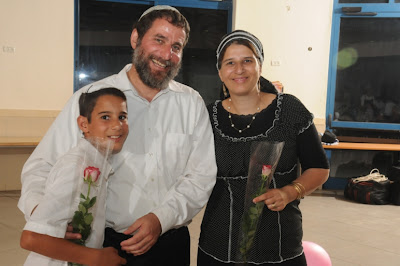
In August, we celebrated the Bar Mitzvah of our son Tovia.


Anat and I and Tovia - our youngest!


Tovia being tossed down the human conveyor belt.
Click here for the full Bar Mitzvah photo album.


Also in August, our 6th grandchild was born, and we celebrated the bris in the town of Ariel. He was named Maayan Ehud Marcus.

Yes, I was the proud grandfather also filling in as Sandak.
Two of my favorite women (my granddaughters to remove any doubt!) with me.

Click here for the full photo album.

Life is sweet! Shana tova and may all of our readers have a year of only simchas!

Print Friendly and PDF

Thursday, September 13, 2012

Yossi Sarid Concedes Defeat

Print Friendly and PDF


We meticulously safeguard your email address and other personal info, so

to receive choice, Pro-Israel content
not available in English anywhere else on the web


I cannot understate the significance of what you are about to read.

Yossi Sarid, the former head of the most radical and strongest Jewish political party in Israel - the Meretz Party - which sought to erase the Jewish towns of Judea and Samaria, concedes defeat. The official numbers of Jews living in Judea and Samaria (the West Bank) have registered loud and clear with Mr. Sarid. "It's too late," he says.

 
The office of Knesset Member Yaakov "Ketzaleh" Katz recently released the official stats of Jews in Judea and Samaria with a breakdown of population by each town. Click here for the report of stats from the Population Registry of Israel's Ministry of the Interior. According to the report, at the end of June, 2012, there were 350,143 Jews in Judea and Samaria, not inlcuding the more than 300,000 in the eastern neighborhoods of Jerusalem.

Yossi Sarid is a highly intelligent, savvy analyst. Though he is an arch enemy of the movement to restore a Jewish presence in the ancient Hebrew towns of Judea and Samaria, he is a smart guy and an eloquent speaker. Reality has sunken in for Mr. Sarid. 

In a recent article entitled, "Tisha B'av: Maybe Next Time We'll Succeed" (Haaretz, July 27, 2012), Yossi Sarid basically throws in the towel. He writes:

 
"Writing this time is especially difficult for me. I am accompanied by a gloomy but deep feeling that I am advancing towards an admission that I erred. And it's no small error. How did I not see the ramifications? ...

[In reference to the settlement movement] "I always convinced myself that what was being done can and will be reversed, and that the long-awaited awakening would surely come. Now it's too late.

[In response to Benvinisti who wrote 25 years ago that the settlements are irreversible] "I wrote then, 'There's no such thing as irreversible. Only death is irreversible.... Why instill premature despair?' He was right. I was blinded and continued to operate on mistaken assumptions... I based my false hopes on common sense... on our ability to stop at any moment and change direction. I was wrong. It's my fault.
"This article will bring joy to the hearts of many. At long last we merit to hear Sarid admitting he was wrong. Blessed [is He] who has let us live to see this day. At long last he understands that the settlements are here for eternity, "from ancient times and forever." [Sarid answers the joy of his opponents with a prediction that the thriving settlement movement will lead Israel to apartheid and its eventual downfall. Thus the name of his article, Maybe Next Time We'll Succeed.]
It will take time for other world leaders and people of influence to wake up and smell the coffee. There will yet be struggles over houses in Judea and Samaria. Yes, the Supreme Court may yet again rule against 20 houses here and demolish 30 houses there. This is an atrocity.
 
But with the waning Arab birth rate and the waxing Jewish one, time is simply on our side. Every day, the Jewish population of Judea and Samaria increases by more than 42. That's more than a classroom a day.
So, the more that world leaders spend time talking, the deeper they dig the grave for their own diplomatic initiatives aimed at uprooting the Jewish People from their ancestral homeland.
Justice has prevailed. The Lion of Judah has awakened and reclaimed his Land. No force in the world can reverse this just, historic process.

"Like" on Facebook
&
To receive timely updates with articles like this one:

One-click unsubscribe link at the bottom of every email

Print Friendly and PDF

Thursday, September 6, 2012

Official Jewish Population Stats in Yesha (West Bank)

Print Friendly and PDF


We meticulously safeguard your email address and other personal info, so

to receive choice, Pro-Israel content
not available in English anywhere else on the web


The numbers which appear below in the Official Population Statistics of Judea and Samaria (Yesha), AKA the West Bank, are not readily accessible to the general public. They come directly from the Population Registry of Israel's Interior Ministry and are painstakingly gathered and formulated by the office of Knesset Member Yaakov “Ketzaleh” Katz.

The growing number of Jews in Judea and Samaria is getting the attention of influential people. Despite headlines of world leaders planning a Palestinian State on Jew-free turf, a slow and quiet Jewish population explosion there has already rendered these designs wholly unrealistic.

As of June 30, 2012, there are over 350,000 Jews living in Judea and Samaria (not including the more than 300,000 in the eastern neighborhoods of Jerusalem which are also technically the West Bank).


Yes, Hillary Rodham. Just look at the official stats below.
 
As per the stats below, the facts on the ground are compelling: it's over; there will never be a Palestinian State in the middle of the Jewish Homeland in the area known as the West Bank. It's only a matter of time before the facts begin to register with people of influence.

In Israel, the smarter, more perceptive political leaders are recognizing this reality. And so it is with former Meretz Party Leader Yossi Sarid who headed the movement to erase the Jewish presence from Judea and Samaria.

Click here to read how Yossi Sarid has thrown in the towel, recognizing that the numbers below are irreversible .

The ramifications are huge. All of us need to change the parameters of how we view Israel and its conflict with the local Arab population. In any arrangement and any initiative, one thing is certain: The Jews of Judea and Samaria are here to stay.

[Scroll down for the Jewish Population Stats of Judea and Samaria]


to our newsletter for more exclusive content
unavailable anywhere else in English on the web.
Fact: You won't see this content anywhere else on the internet in English


Jewish Population Stats for Judea and Samaria
as of June 30, 2012
Population Registry of the Interior Ministry

Judea and Samaria Jewish Population: 350,143
as of June 30, 2012
[Not including more than 300,000 Jews in eastern neighborhoods of Jerusalem]

On Dec. 31, 2000, there were 190,206 Jews in Yesha
On June 30, 2009, there were 301,754 Jews in Yesha
On June 30, 2010, there were 320,073 Jews in Yesha
On June 30, 2011, there were 334,564 Jews in Yesha
On June 30, 2012, there were 350,143 Jews in Yesha

The Jewish population increased in this region in the last year by 4.65%.

Below are the stats for each town in Judea and Samaria. The population of some small villages are recorded in the registry as part of larger neighboring towns as in the case with Shiloh and its neighboring villages.
                                               
Northern Samaria
Chinanit 990
Chermesh 228
Mevo Dotan 365
Rechan 197
Shaked 693
Total 2,473

Ariel-Elkana Bloc (Trans Samaria H’way)
Revava 1,552
Oranit 7,378
Alfei Menashe 7,947
Elkana 3,739
Ariel  18,638
Barkan 1,586
Elei Zahav 1,088
Etz Efraim 885
Peduel 1,409
Kiryat Netafim 683
Shaarei Tikva 4,872
Total 49,777

Maaleh Adumim Bloc
Maaleh Adumim 38,647
Kfar Adumim 3,334
Mitzpeh Yericho 1,975
Keidar 1,148
Total 45,104

Eastern Etziyon Bloc
Maaleh Amos 452
Nokdim 1,306
Tekoa 2,470
Metzad-Asfar 444
Total 4,672

Samaria Bloc
Itamar 986
Elon Moreh 1,605
Bracha 1,817
Yitzhar 1,201
Migdalim 150
Shavei Shomron 821
Avnei Hefetz 1,638
Yakir 1,671
Kfar Tapuach 1,195
Maaleh Shomron 834
Nofim 496
Salit 558
Immanuel 3,492
Einav 722
Tzofim 1,426
Kedummim 4,081
Karnei Shomron 7,137
Total 29,830

Beitar Illit
Beitar Illit 43,257
Total 43,257

Kiryat Sefer Bloc
Hashmoniam 3,008
Kiryat Sefer (Modiin Illit) 55,672
Matitiyahu 497
Total 59,177

Jordan Valley Bloc
Avnet  80
Almog 210
Argeman 165
Bet HaArava 108
Bekaot 207
Gittit 330
Galgal 165
Vered Yericho 249
Hemdat 161
Hamra 157
Yetav 276
Yafit 175
Mehola 454
Mechora 154
Maaleh Efraim 1,591
Mitzpeh Shalem 204
Mesua 189
Maskiot  86
Niran  76
Naama 136
Netiv HaGedud 179
Fetzael 273
Kalia 363
Roi 155
Rotem  101
Shadmot Mehola 576
Tomer 305
Total 7,125

[Gush] Etziyon Bloc
Elon Shevut 3,501
Elazar 2,245
Efrata 9,143
Bat Ayin 1,195
Har Gilo 787
Karmei Tzur 859
Kfar Etziyon 650
Migdal Oz 423
Neve Daniel 2,278
Rosh Tzurim 862
Total 27,763

Hevron Hills Bloc
Adura 291
Eshkolot 672
Hevron 599
Haggai 564
Tene 719
Carmel 468
Maon 487
Metzudat Yehuda 434
Negohot 260
Susia 945
Otniel 731
Pnei Hever 396
Kiryat Arba 7,180
Shima 386
Telem 255
Total 14,387

Binyamin Bloc
Bet El 5,984
Bet Aryeh 4,286
Bet Horon 1,201
Geva (Adam) 4,548
Givon Hahadasha 1,332
Givat Zeev 13,955
Dolev 1,370
Har Adar 3,935
Halamish 1,197
Talmon 3,370
Kochav HaShahar 1,953
Kochav Yaakov 6,895
Kfar HaOranim 2,408
Mevo Horon 1,844
Maaleh Levona 635
Maaleh Michmash 1,499
Nachliel 525
Nili 976
Naaleh 1,056
Ofrah 3,199
Ateret 520
Almon (Anatot) 1,170
Psagot 1,894
Rimonim 626
Shiloh 2,771
Eli 3,249
Total 72,398

"Like" on Facebook
&
To receive timely updates with articles like this one:

One-click unsubscribe link at the bottom of every email

Print Friendly and PDF

Friday, August 31, 2012

Israel Folk Music Concert in Bet El

Print Friendly and PDF

For those of you not intimately familiar with the Israeli folk tunes scene, one of THE most popular bands which came on the scene in the 1960's and continues until today in a different line up is The Parverim.

The Parverim on stage in Bet El

I would compare them to Simon and Garfunkel in their popularity and voice harmony.

The Parverim came to Bet El last night and the Be'er Sheva Philharmonic Symphony joined in for a spectacular performance.

Enjoy some of the highlights!

"Like" on Facebook
&
Subcribe below to the "Bet El Rocks" newsletter

Print Friendly and PDF

Friday, August 3, 2012

A Less-Known Reason for Tu B'Av Rejoicing

Print Friendly and PDF

If you ask a secular Israel on the street what is Tu B’av (a mini-holiday which falls on Aug 3, 2012), he will inevitably answer, “The Holiday of Love.” And, in fact, there is an aspect of love in the holiday, because it was today that the tribe of Binyamin, some 2900 years ago, was allowed entry back into the Jewish People in an unusual, mass-engagement ceremony.  

The bachelors of Binyamin hid in the vineyards of the town of Shiloh, and as the young maidens of Israel came out to dance in the vineyards, each man came out of hiding and selected for himself a bride.  


Because of this historic event, which saved the tribe of Binyamin from extinction, Israelis today call this holiday the holiday of love.

The Talmud in the tractate of Taanit page 30 folio B, tells of seven historic events which occurred on Tu B’av, and each one is reason enough to establish Tu B’av as a day of rejoicing. I will explore one of the less known reasons.

The Talmud calls this day “Tever Magal” which means the day of “breaking the axe.” What axes is the Talmud talking about and why is breaking them a reason for celebration? Let’s try and answer this by understanding the historical background

When the Jewish People returned to build the second temple under the leadership of Ezra and Nechemia, they needed a steady supply of wood to burn the fire on the mizbeach (alter) which consumed the burned parts of the temple sacrifices. But there was a dire lack of trees in Israel since the goyim had cut down all the forests.

It became a major issue to find wood for the alter, and the elders of Israel decided to turn donations of wood (nidvat etzim) into a central and important offering brought with the same pomp and circumstance as the Bikurim fruits offering.

In the temple, they accepted wood offerings until the 15th of Av, and then they wouldn’t accept anymore wood for the mizbeach (alter) until the following year. Why did they stop chopping down trees for wood on the alter on Tu B’av?

Tu B’av falls towards the end of the summer months when the sun begins to lose its strength. Wood chopped down at a time that the sun isn’t strong enough would remain moist and attract worms, thereby disqualifying it from being used on the alter. So, the Rabbis sought a cut-off date as summer nears its end after which they didn’t want to risk accepting wood which might have worms in it. They chose the 15th of Av as the cut-off date.

Since the axes used for this task were stored away on Tu B’av, the day took on the name as “breaking the ax day,” which can really mean placing them in storage. The completion of the mitzvah of preparing wood for the alter for the entire year was, in itself, a reason for joy. But there’s more to the joy.

The enemies of Israel in the time of the Second Temple sought ways to disrupt the Temple service. They issued a decree forbidding Jews to bring wood for the Temple alter and established roadblocks outside of Jerusalem to catch those who dared defy the decree.

What did the Jews do to keep the Temple service going? How could they possibly get wood through the roadblocks?

The Talmud tells that Jewish ingenuity kicked in as the Jewish pilgrims made ladders out of the wood and told the roadblock guards that they were on their way to collect chicks out from birds nests near Jerusalem, a common task at the time. Once they passed the roadblock, they dismantled the ladders and brought the wood to the Temple.

These Jews risked their lives defying the decree. Part of the joy of Tu B’av is a salute to these heroes whose Jewish ingenuity combined with readiness to sacrifice enabled the Temple service to continue.

Let’s review the two reasons for joy on Tu B’av that we stated:

1)      It is the last day of the important mitzvah of bringing wood for the alter, and we always rejoice upon completion o f a mitzvah.

2)      We salute and praise those Jews who endangered themselves to supply wood for the alter.

Rabbi Mordchai Eliyahu, of blessed memory, would emphasize another joyous aspect of the day we “break the ax.” Since the arduous task of cutting down trees and chopping the wood ended on Tu B’av, much time freed up from this day onward for Torah study. We increase our study both in quantity and quality on Tu B’av. Thus, the joy on this day is the joy of increased Torah study.

The study of Torah is the replaces the wood on the alter, as our Rabbis said: One who engages in Torah study on the long winter nights with candlelight, is as though the temple is rebuilt in his days, and the wood on the alter rages in flames providing light for him to continue his study.

The above is my son Tovia's Bar Mitzvah Speech which was delivered last night at his Bar Mitzvah celebration in Bet El. The two of us studied together about Tu B'av to enable him to write his speech. Below are some pics and highlights from the "Thank you's" part of the speech.

Tovia leading the Maariv prayer service for the first time in his life. The proud father (me) looks on.

Highlights from end of speech:

Now I reach the cherry on top of the whipped cream that everyone likes. The Thank you’s.
First of all, thank you to G-d for all the good which surrounds me, my family, my friends, my grandparents and parents.

And to you my good friends, thank you for participating in my simcha!

Bar Mitzvah boy Tovia on top of the pyramid

To my family – I remind you that I am the youngest Bar Mitzvah of this generation. I am the youngest grandchild on both sides. So take advantage of this event, and remember it for the rest of your life, because in it we are sealing off the generation.

I hope that your gifts to me reflect this added importance.

To my Uncles and Aunts, you are the greatest. You have watched me grow from the side. From now on, I am responsible for my own deeds.

As I reflect on my own extensive experience as an uncle to many nephews and nieces, I can say that being an uncle is not always an easy task. Uncles and Aunts have a lot of work, and for this I thank you.

To my brothers and sisters, thank you for all you have given me and done for me. Your brotherly love will stay with me for my entire life. Thank for being by my side, for supporting me, and for criticizing me, both constructive and non-constructive criticism.

And last but not least my parents who have brought me to this stage in my life. To Ima who carried me for nine months in her stomach, and to Abba who helped her and prayed for my success. For the giving of all these years, and the education. Thank you.

Thank you for the times you said “no,” and thank you even more for the times you said, “yes.” Thank you for the merit to grow up in your home.

"Like" on Facebook
&
Subcribe below to the "Bet El Rocks" newsletter
Print Friendly and PDF

Sunday, July 29, 2012

How To Emerge From the Tisha B’av Fast Day

Print Friendly and PDF

By Rabbi Zalman B. Melamed
Rosh Yeshiva of the Bet El Yeshiva Center

A talk to students in the Bet El Yeshiva Center at the end of the Tisha B’av Fast

Every year when the Tisha B’av Fast Day ends and mashiach (the messiah) doesn’t come, a feeling of intense mourning settles in with no consolation in sight.

But, Rabbi Avraham Yitzhak HaCohen Kook of blessed memory, Israel’s first Chief Rabbi and the father of religious-Zionist thought, shows us a way to consolation: Tisha B’av is a day of mourning and great sorrow over the destruction, but we know also that on Tisha B’av, the mashiach is born.
Rabbi Avraham Yitzhak HaCohen Kook, founder of religious-Zionist thought in Israel


On the one hand, we are mourning and pained over the continuing state of destruction, as it says, “Anyone who during his days the Temple is not rebuilt, it’s as though the Temple was destroyed in his days.” The continuation of the state of destruction means that the sins of past generations haven’t been rectified, or at least not fully amended.

On the other hand, we can definitely be consoled by the droplets of consolation, as Hashem shows us the first illuminations of the light of mashiach.

Many generations of Jews saw no change for the good whatsoever. Troubles were followed by more troubles, trials were followed by tribulations, and there were no beginning signs of redemption from suffering.
However, in recent generations, the process of deliverance from our troubles has begun. From a spiritual standpoint, the sparks of rebirth began 400 years ago with the Arizal and Rabbi Yosef Karo.

Then, some 150 years ago, an awakening of aliya (moving) of Jews to the Land of Israel began. Not an aliya of individuals, but a growing, developmental process of aliya to the point that today there is approximately 50% of world Jewry in Israel – soon a majority of our nation will be in the Land of Israel. While we don’t currently inhabit all parts of our land, we are sovereign over many parts of it. This constitutes droplets of consolation.

But what we need now is not consolation, rather action. We have to take hold of ourselves and know that each one of us has the ability to contribute to the nearing of our nation’s redemption. When a Jew becomes a better person, he is bringing the redemption nearer.

First and foremost, we must increase Torah study. Many of the great sages of the esoteric aspects of the Torah have said that the final redemption will come about in the merit of Torah. Diligence and determination in Torah study, and especially the study of emunah, which is a wrapping around the secrets of the Torah – these are great devices which advance us towards mashiach. 

Students escorting Rabbi Shlomo Fisher after a class at the Bet El Yeshiva

It is incumbent upon us to cultivate people with great spiritual prowess, people with great capabilities of spiritual leadership, who will shine forth great light, and will begin the needed revolution of teshuva en masse.

The revolution of teshuva must start at home with us. To the extent that we will each serve as a personal example with refined character traits, imbued with wisdom and Torah knowledge, then our influence will intensify and we will effect change. This is a role that is incumbent upon each of us. We are the backbone of the nation.

There are many Torah scholars who engage in intense Torah study but are detached from the nation, that is, from a large part of Am Yisrael, who are distant from Torah and mitzvoth, though loyal to the Jewish People.

There are Israelis who are not connected in any way to Torah and mitzvot and could move overseas and get salaries 5 or more times what they are getting in Israel. There are excellent doctors, hi-tech workers, and other professionals who could earn much more in other countries, and live with a much higher standard of living, but despite all, they don’t want to leave Israel because this land is our home. 

Israeli startup entrepreneurs

In other words, deep inside, they have a bond to the nation, not an external connection, rather something very internal that cannot be explained. Many Israelis are loyal to the Jewish State, as government workers in various offices and in the army, who are distant from Torah and mitzvoth. We must bring all parts of the nation together.

We, who are engaged in the study of the Torah of Eretz Yisrael, must accept the role of being a backbone, and uniting the different parts into one. We must cultivate Torah giants in the spirit of Rabbi Kook, strive to reach his heights and uplift the nation.

A person who does not act, who is not agile, resourceful and imbued with spiritual courage, he will not be consoled; rather, he will continue to see our nation’s state of affairs as terrible and difficult.

But, a person who is engaged at all times in progress, who acts and influences, he will see things differently. We must act with all of our spiritual prowess, and find consolation in our positive accomplishments. 
"Like" on Facebook
&
Subcribe below to the "Bet El Rocks" newsletter

Hebrew Source: http://www.yeshiva.org.il/midrash/shiur.asp?id=6164&cat=408&q=תשעה,באב,

Print Friendly and PDF

Friday, July 27, 2012

Arafat’s Death: The Missing Link

Print Friendly and PDF


Yasser Arafat, also known as Mohammed Yasser Abdel Rahman Abdel Raouf Arafat al-Qudwa al-Husseini, posthumously made headlines earlier this month after his widow, Suha, produced a bag of her late husband’s belongings on which were found traces of radioactive polonium, a deadly poison.

Officially, we were told in October 2004 that Arafat had a bad flu after he vomited during a meeting. His situation deteriorated and Israel allowed him to be flown to the Percy Military Hospital in a Paris suburb. According to the Associated Press, doctors announced a month later at his November death that he suffered from a blood condition known as disseminated intravascular coagulation, "although it is inconclusive what brought about the condition.”

But now, seven and a half years later, Suha’s findings have led to demands that his remains be examined to determine if it was the Zionist regime that poisoned him.


"Suha, the Zionists killed me."
Poisoning? How about AIDS?
Haaretz newspaper reported that both Israeli and foreign professors who examined the French hospital's medical report said that Arafat bore all the symptoms of AIDS. But no further evidence of AIDS was offered.

The Missing Link
My very close friend “D” is a service provider near the King David Hotel with many clients who are overseas nationals. “D” is a very friendly person, and people who get to know him tend to bond quickly beyond their business dealings.

Lo and behold, the French Consulate in Jerusalem is located right across the street from the King David Hotel, and a veteran French worker at the consulate is a longtime client of “D”.

The French Consulate in Jerusalem

The consulate worker visited my friend for a business matter and as the two sat, the Frenchman opened up to D saying he had something on his mind.

“At the time of Arafat's death, I was asked at the consulate to single-handedly process all the paper work for his transfer to the Paris hospital. I saw medical reports which included the department he was being transferred to in the hospital.”

He paused for what seemed to “D” like a long time, as though he was having difficultly continuing.

“Arafat was transferred to the AIDS ward in Paris. That’s what the reports said. No one ever reported it.”
Arafat, you actually do make me sick. How old was the boy you got AIDS from?

The Frenchman went on to explain that one of the reasons the family chose France as a destination is because of rigid laws there which keep cause of death guarded in secrecy even posthumously.

So there you have it. It appears that not the Zionist regime, but rather Arafat’s own degenerate and debauched escapades terminated his terrorist career.

Suha, I am so sorry to spoil the party.

"Like" on Facebook
&
Subcribe below to the "Bet El Rocks" newsletter

Print Friendly and PDF